By Jamie Swenson, Associate Creative Director
Overview
What is a belief, and why does it matter to a brand? Belief Agency CEO Jonathan Dunn explains how an organization’s belief shapes its decisions, culture, marketing, and customer relationships—and why understanding what you believe is the starting point for building an authentic brand.
Jonathan Dunn has a healthy distrust of traditional marketing. From his punk rock upbringing through more than a decade in the music industry to his eventual role as CEO of Seattle-based Belief Agency, his perspective has been shaped by a simple conviction: The truth is more powerful than manipulation.
Growing up as a punk rock kid in the ’90s, Jonathan was surrounded by a culture that questioned authority and had a low tolerance for BS. He remembers looking around and wondering who was actually telling the truth. He saw an industry where success could mean manipulation, half-truths, and sometimes outright lies. Companies often seemed to start with some version of the same question: What do we need to say to get people to buy this?
He became interested in different questions: What if you started with what was actually true about your company? What if telling the truth wasn’t a limitation? What if it was actually a better way to build a business?
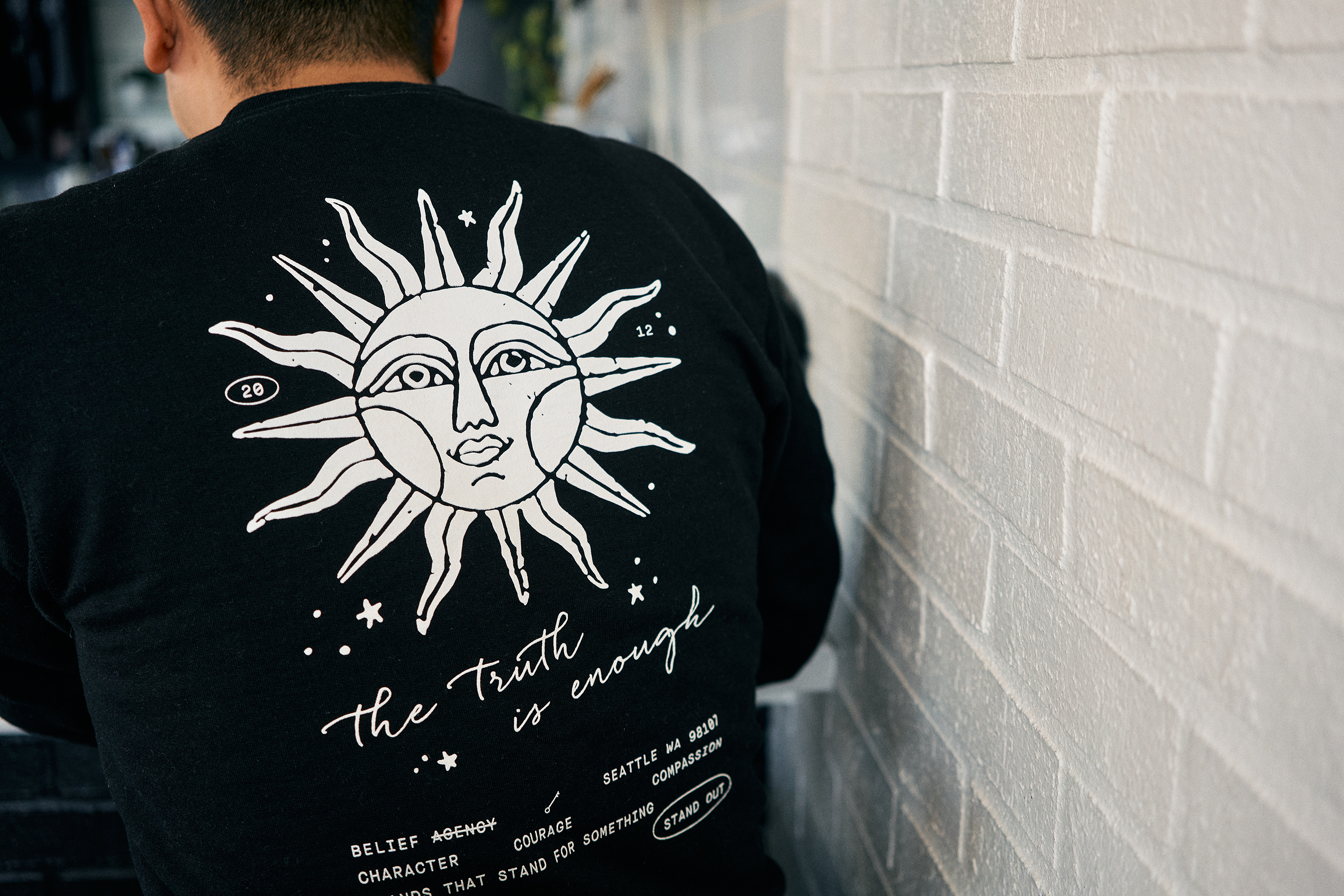
Those questions eventually became foundational to Belief Agency. Our belief is simple: The truth is the key to success. We start by helping organizations uncover and articulate their own truth—and then we bring it to life. We’ve done this successfully for hundreds of organizations across many industries, from construction, healthcare, and technology to consumer products, mission-driven organizations, and public agencies.
But what do we mean when we say “belief”? Why does it matter? And what can you do once you’ve identified your belief? I sat down with Jonathan to ask him a few questions we get all the time.

Jonathan: At the simplest level, a belief is something you hold to be true. For an organization, it gets to how you view the world and your place in it. Philosophically, I think belief shapes the way that we see the world and act in it—and that shapes the world that we build. That could be the world of our family, our community, our neighborhoods, our employees, and our customers, or it could be the capital-W World.
So when we work with an organization, we’re not starting by trying to come up with the smartest or most compelling thing they could possibly say. We’re trying to get to something that’s already true about what people actually believe, and from that center, make decisions about the brand.
Jonathan: I’m definitely a fan of Simon Sinek and all the work that he’s done. When we were first putting our thinking together, his book “Start With Why” was big, and everybody was talking about it. But there was another level deeper that could be even more powerful than why.
What I mean by that is: What do you actually believe? What do you believe about yourself? What do you believe about your community and the people you serve? How do you see the world and your place in it?
Because when it comes down to it, what you believe shapes what you actually do.

Jonathan: One of the things I come back to is that if you truly value something, it’s probably going to cost you something.
For example, it’s easy to say that quality matters. OK, great. But if you call yourself a luxury brand, are you willing to buy the more expensive material and take the hit on your margin because you actually believe it makes a better product? This is where it starts getting interesting, because a belief isn’t just something you say. It starts showing up in the choices you make, including the choices where there’s a cost.
Jonathan: A brand is a feeling. If I say Nike, you have a feeling. If I say Walmart, you have a feeling. That feeling comes from all these different interactions you have with a company. You see the advertising, go to the website, talk to a salesperson, buy a product, deal with customer service. All of those touchpoints create a feeling. And is that feeling consistent with how the brand positions itself?
That feeling also has to show up inside the organization. How well a brand is delivered externally depends on how well it’s understood internally.
So how do you live out your brand in an authentic way where it’s not just that the marketing is resonating with the right people and they’re clicking on your website and buying your widgets?
When all those things line up, people aren’t just hearing you tell them who you are. They’re experiencing it, and that’s where you start to build trust.
Jonathan: It gives you clarity. You can start looking at the business and asking: Why are you making widgets? What’s the origin story? Why does it matter? What’s that inciting incident?
Maybe it’s, “I was making widgets down the road at this other factory, and they treated people like garbage, and I was like, there is a better way to do this. So I started my own widget factory, where we don’t treat people like that, under the belief that people deserve better.”
That’s powerful, right?
Then you can ask: How has that played out in the way you’ve structured your company, the kind of people that you’ve hired, and the way that you take care of your employees? And how do those beliefs influence how you market, how you run your customer service, and how you make the product itself?
That’s really the idea behind Belief Agency. Our differentiation is that we believe good marketing is telling the truth. No lies, no manipulation, just truth well told that inspires people to action.
We always say, “When you know who you are, you know what to do.”